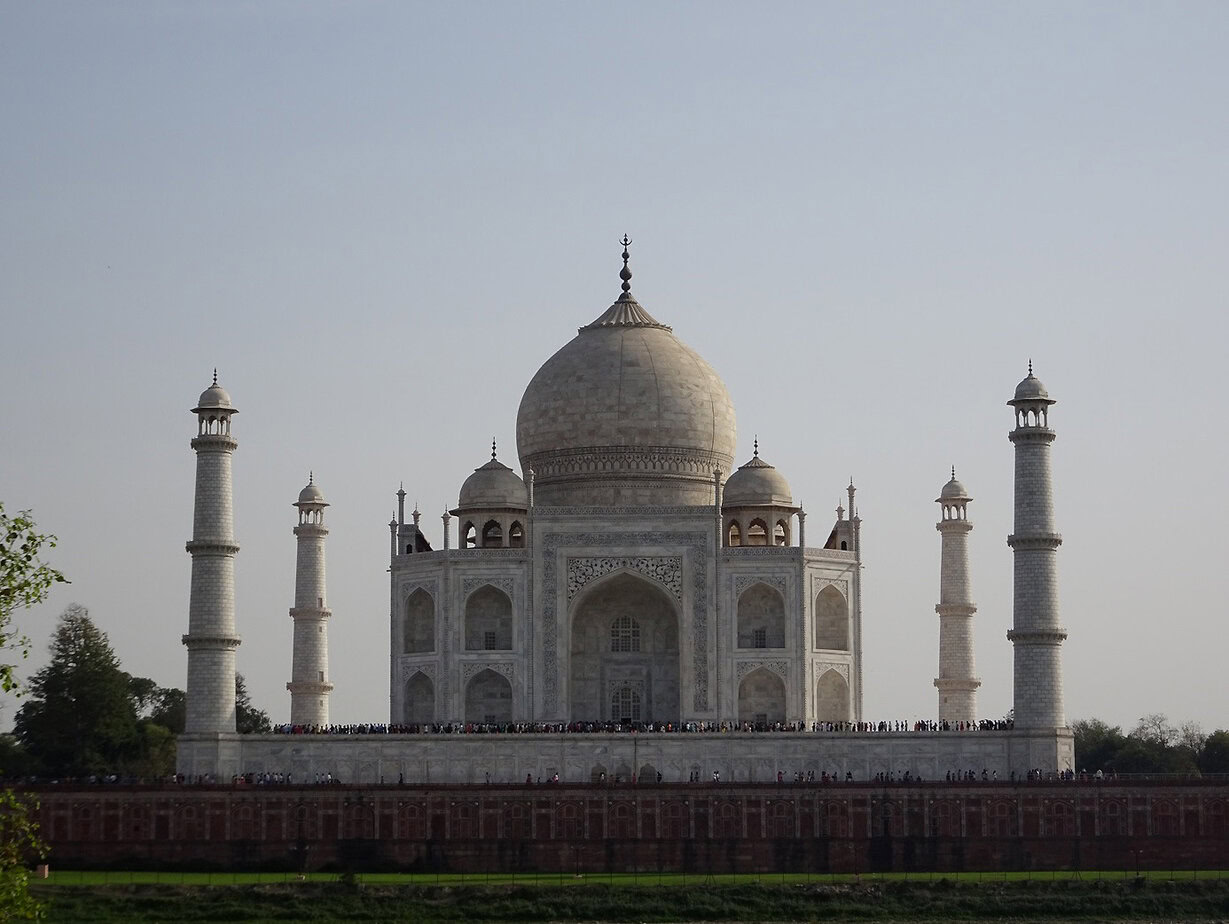
I’m sure I don’t need to introduce Agra to you. After all, it’s one of the most famous cities in India, maybe even the world, because it’s home to two of its most famous building complexes: The Taj Mahal and the Red Fort.
It seems like lots of people only stop by for a short time to visit these two sights and then quickly move on to other highlights in the country. We’re always fans of taking it a little more slowly, so we spent a few more days in Agra to really get to know the city.
Just as we expected, we found many more places in Agra worth checking out. For instance, I’m convinced that Akbar’s Mausoleum and Itimad-ud-Daula would be treated as must-see sights if they weren’t eclipsed by the more famous Taj. Here’s my 2-Day Itinerary for this fascinating city.
This post may contain affiliate links, and I might earn a small commission at no additional cost to you. For more info, click here.
Guided Tours of Agra
If you want to skip the hassle of sorting out your own transportation (which can get a little tricky in Agra), there are a number of guided tours of the city’s highlights available. You can have a look at some options below.
A 2-Day Itinerary for Agra
Agra was the most important capital of the Mughal Empire, and traces of that period are scattered all over the city. As someone who’s very interested in historical architecture, I really liked how you could trace the development of different styles under the successive Emperors, especially in the tomb buildings.
Akbar mostly commissioned massive red sandstone structures (which you can see in the outer walls of Agra Fort or Akbar’s own tomb), while his grandson Shah Jahan perfected the more graceful white marble style (like in the Taj Mahal).
In between you have some buildings in a transition style (like Itimad-ud-Daulah) from the time of Akbar’s son Jahangir, which combine elements of both. It’s easily possible to see all of these and a few other, minor sights if you spend two days in Agra.
If you’ve got only one night in town, I recommend leaving the Taj Mahal for the second day, so you can get there as early as possible. In that case, you can use the first day to check out some of the smaller sights, get familiar with the city and visit the Red Fort in the late afternoon, when it’s a little quieter.
The Best Hotels in Agra
Budget: Big Brother Hostel
Midrange: Hotel Ten Square
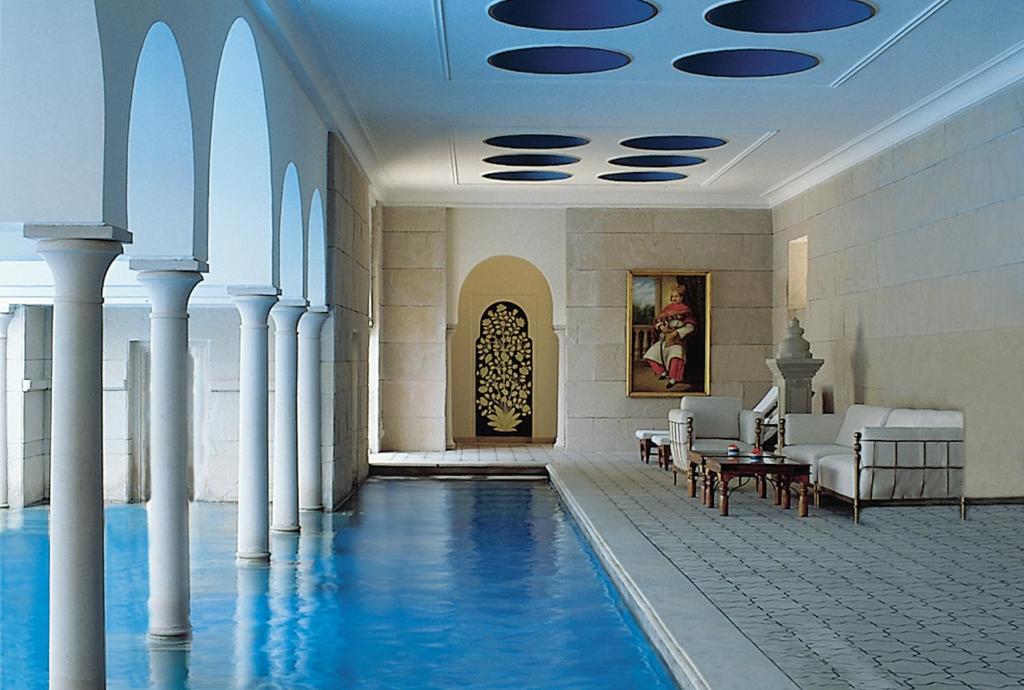
Luxury: The Oberoi Amarvilas Agra (pictured)
.
Day 1
Itimad-ud-Daulah (Baby Taj)
The eastern bank of the Yamuna River is home to a number of smaller tombs that are absolutely worth checking out. In any city without a Taj Mahal, they would be major sights, but here they seem to be little known. We met four other foreigners at the Itimad-ud-Daulah and none at the Chini ka Rauza.
Itimad-ud-Daulah was my favourite among these monuments. It’s a tomb that was built in the early 17th century by Empress Nur Jahan for her father Mirza Ghiyas Beg, who had served as a high-ranking official in the Mughal court.
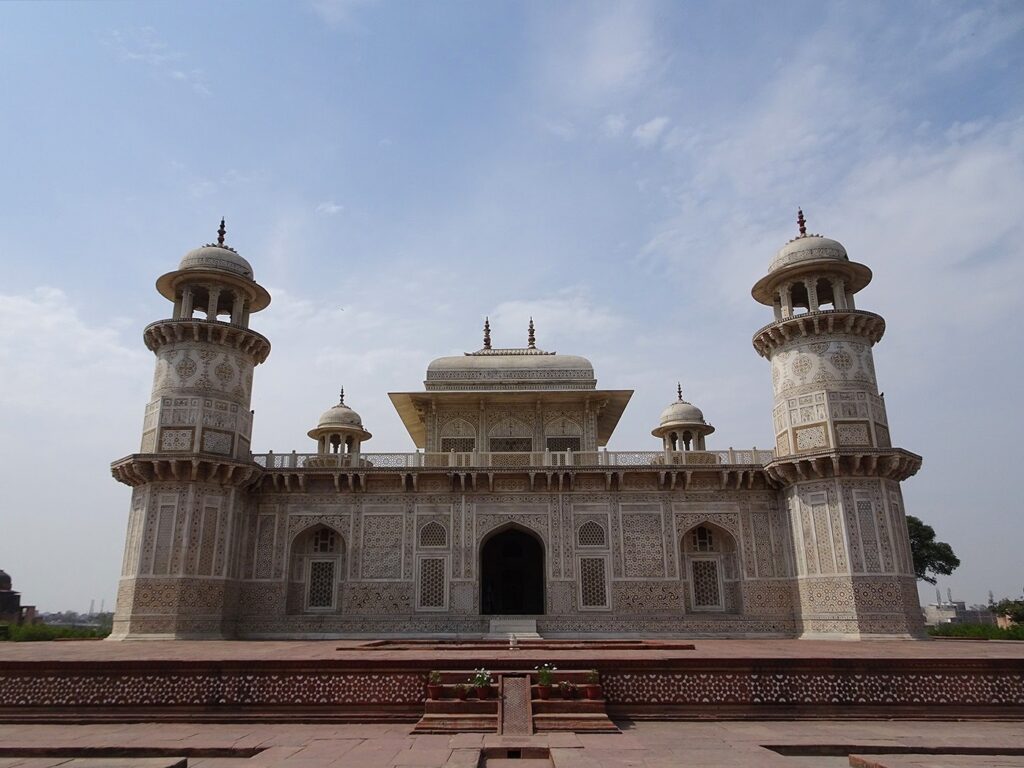
Architecturally, I found it quite interesting because it marks the transition between earlier Mughal red sandstone architecture, which you can see in the four gateways at the end of the garden paths, and the white marble style of the main tomb, that culminated a little later in the Taj Mahal.
In the city it’s also known as the “Baby Taj”, which I found a bit reductive, as it’s very beautiful in its own right and I didn’t even think that it resembled the Taj very much. Of course, it’s much smaller but the decoration of the walls looked even more intricate than at the Taj Mahal.
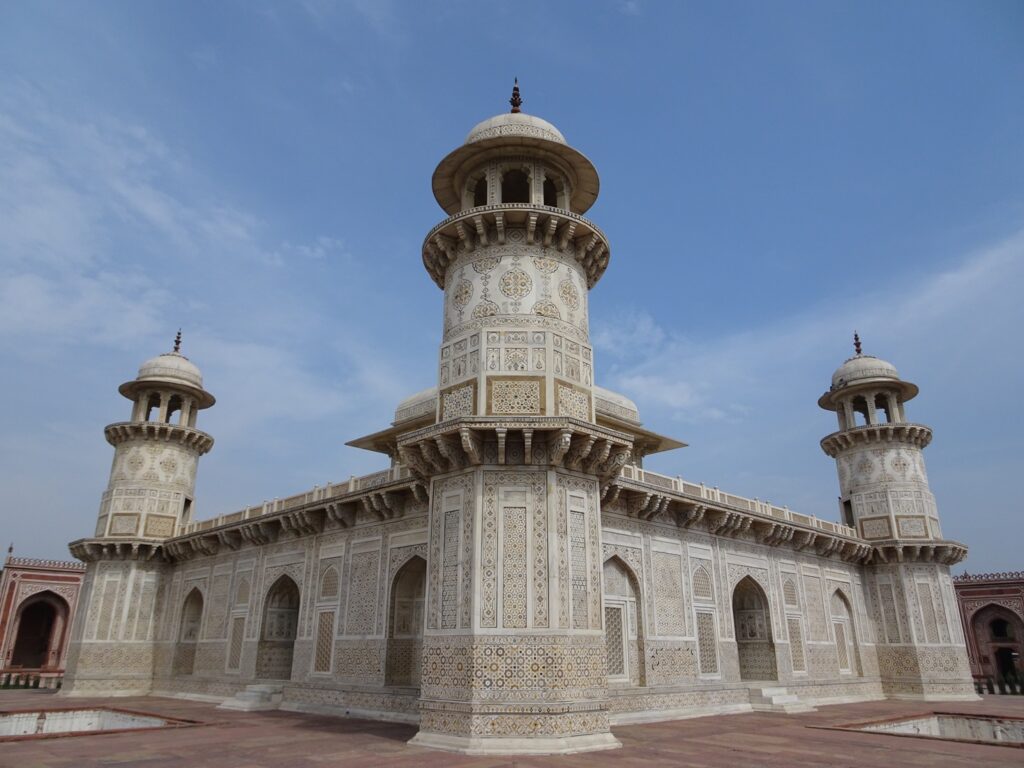
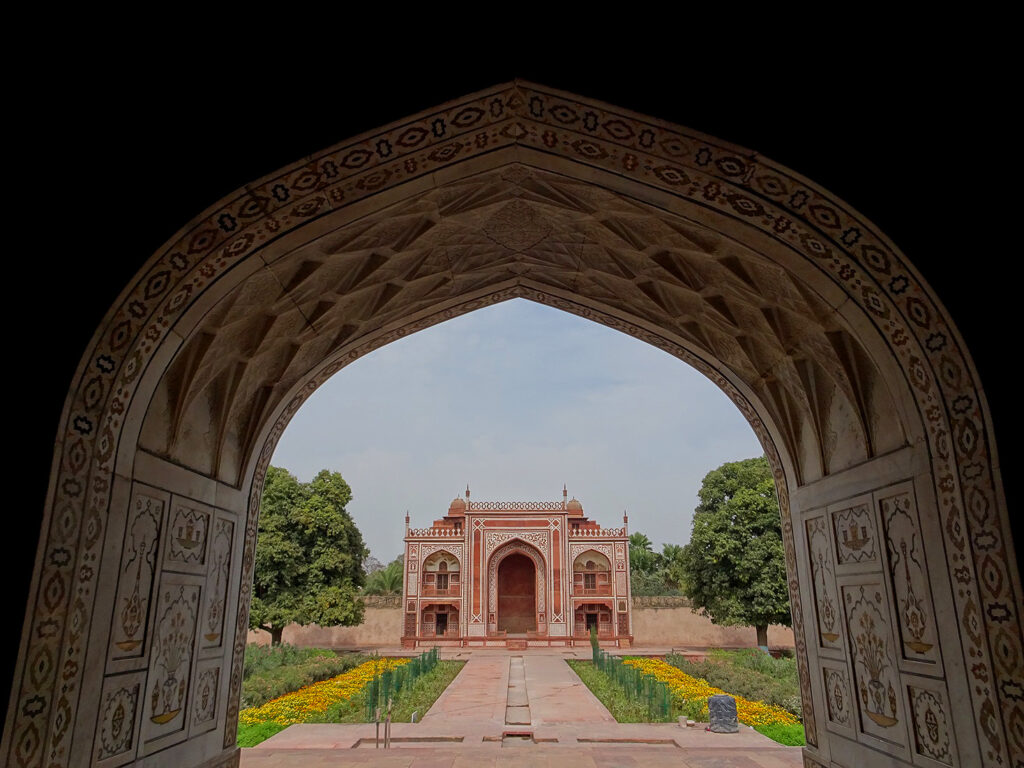
As I said, we didn’t meet many people here, so we could take our time to inspect the details a bit more closely. The entire outside walls are covered with pretty patterns of inlaid marble and inside the tomb there are some really well-preserved paintings of flowers and blooming trees, which are supposed to be symbols for paradise.
Something else I really liked here was the pretty symmetrical charbagh garden that surrounds the tomb on all sides. Different from the Taj Mahal, the tomb is in the centre of the garden here, which is actually the ‘proper’ and more common placement.
Practicalities
The complex is open daily from sunrise to sunset and we paid 300₹ per person. We walked to both tombs at the eastern bank from Agra Fort by crossing the Yamuna on Strachey Bridge north of the fort and then following National Highway 39 north, which took us about 45 minutes to Itimad-ud-Daulah and another 15 minutes to Chini Ka Rauza.
If you’re short on time, it’s probably best to get a auto rickshaw instead. In that case, I recommend getting one to Itimad-ud-Daulah, then walking north to Chini Ka Rauza and catching another rickshaw back to central Agra (instead of asking the driver to wait twice, which would be more expensive).
Chini Ka Rauza
About 1km further north along the eastern bank of the Yamuna lies another tomb, called Chini Ka Rauza, which was even quieter when we visited. There was just a bunch of local teens hanging around, otherwise we had the area completely to ourselves.
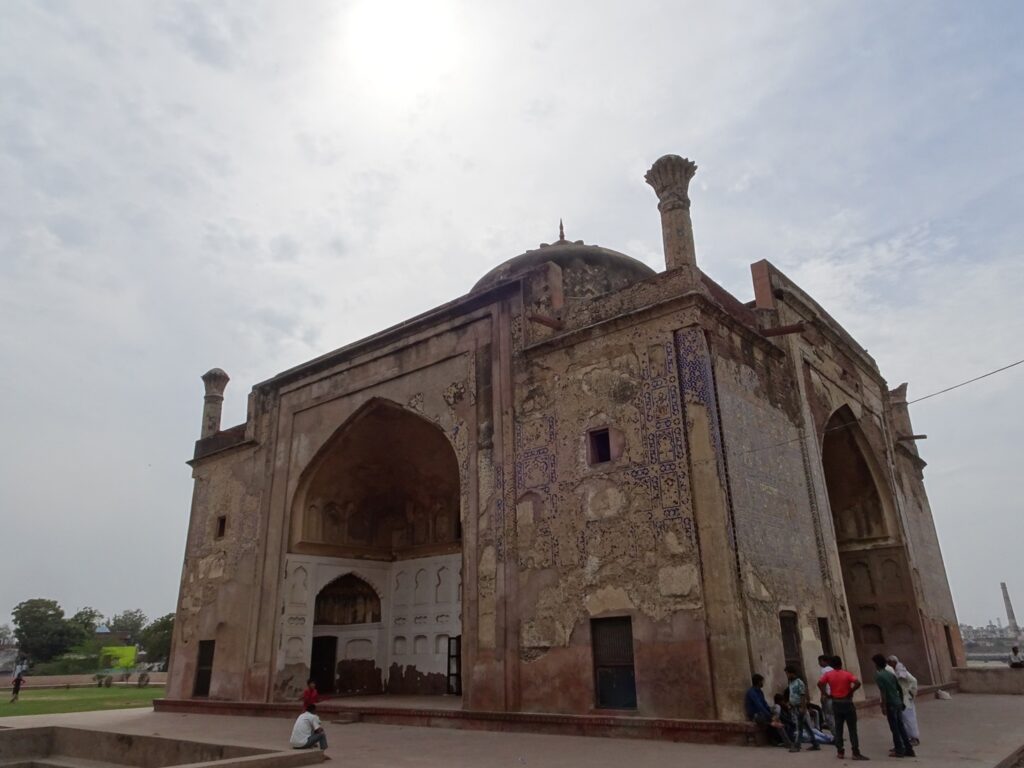
Once again, the outside has a decoration consisting of some colourful glazed tiles, but these were produced in Persia. In fact, the whole building is built in an architectural style from that part of the world, because the tomb was built for Afzal Khan, a Persian scholar and poet who served under Emperor Shah Jahan (who built the Taj Mahal).
The tiles aren’t half as well-preserved as the ones at the Itimad-ud-Daulah, but I kind of thought that the slightly ruined appearance gave the place part of its charm (although that might just be the archaeologist in me speaking).
The interior is much better preserved, however, and the walls and domed ceiling are covered with more beautiful patterns of coloured glazed tiles.
Practicalities
Once again, the complex is said to be open from sunrise to sunset and there was no entrance fee when we visited. To get there, follow the highway north and turn left at the small Sri Radha Krishna Temple, which has a golden-topped white spire.
There were auto rickshaw drivers hanging around at the intersection when we were there, if you don’t want to walk back the entire way to the fort area.
Red Mosque (Jama Masjid)
Now it’s time to explore Agra’s fort area. Before visiting the fort, I recommend having a look at the impressive Red Mosque across the train tracks to the northwest.
The mosque was commissioned in the 17th century by Jahanara Begum, the daughter of Shah Jahan, and it’s still one of Agra’s most important religious buildings. Architecturally, it fits in well with the other nearby Mughal monuments and it used to be connected to the Fort by a big courtyard (until the British ran their train tracks right through it).
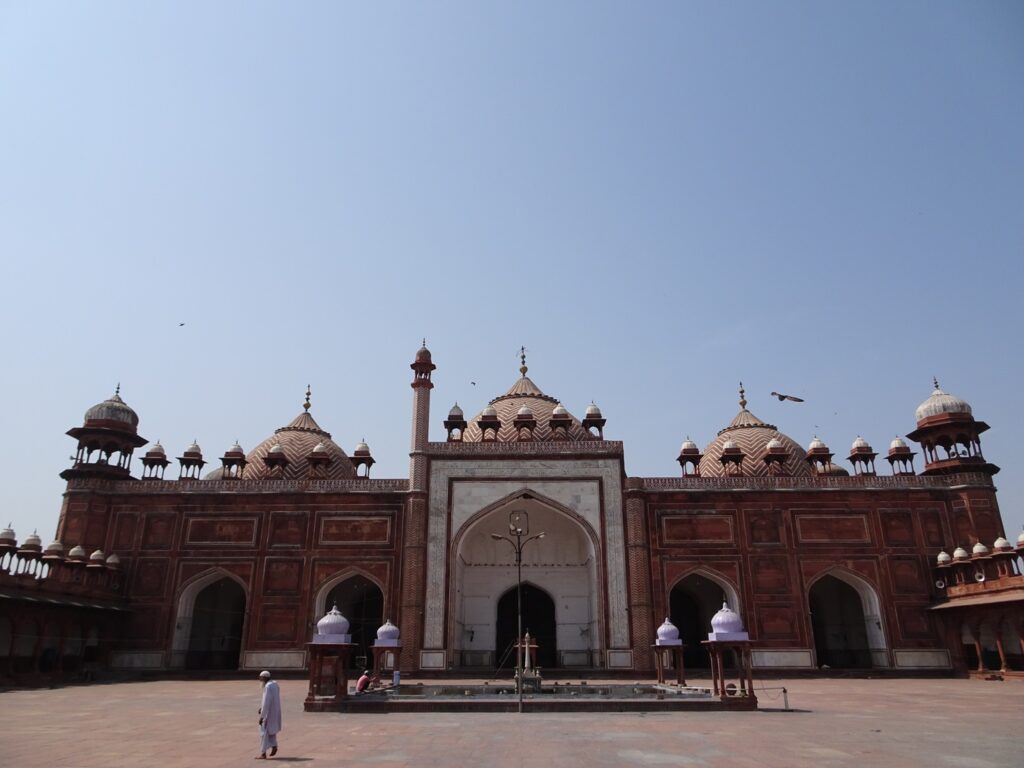
The mosque is mainly built of red sandstone, so it’s a bit of a callback to the style of Akbar’s Mausoleum or the early palaces in Agra’s Fort, but there are some white marble elements, especially around the large main gateway. The large central courtyard and striped bulbous domes are classic elements of later Mughal design.
Interestingly, the mosque was almost empty when we visited, despite its location in the middle of the city centre. It really seems like everyone is just crowding to the Taj Mahal and Agra Fort and ignoring all the other cool sights in the city. There’s no entrance fee.
Agra Fort
After visiting the mosque, I recommend grabbing a bite to eat and then moving on to Agra Fort in the late afternoon or early evening, when there won’t be so many people around.
Agra Fort was the main imperial residence of the Mughal emperors before the capital shifted to Delhi, so there are lots of administration buildings as well as living quarters inside the walls.
Emperor Akbar began building the fort in the 16th century, using mostly red sandstone, but later rulers like Jahangir and Shah Jahan added marble palaces, mosques and audience halls inside the compound.
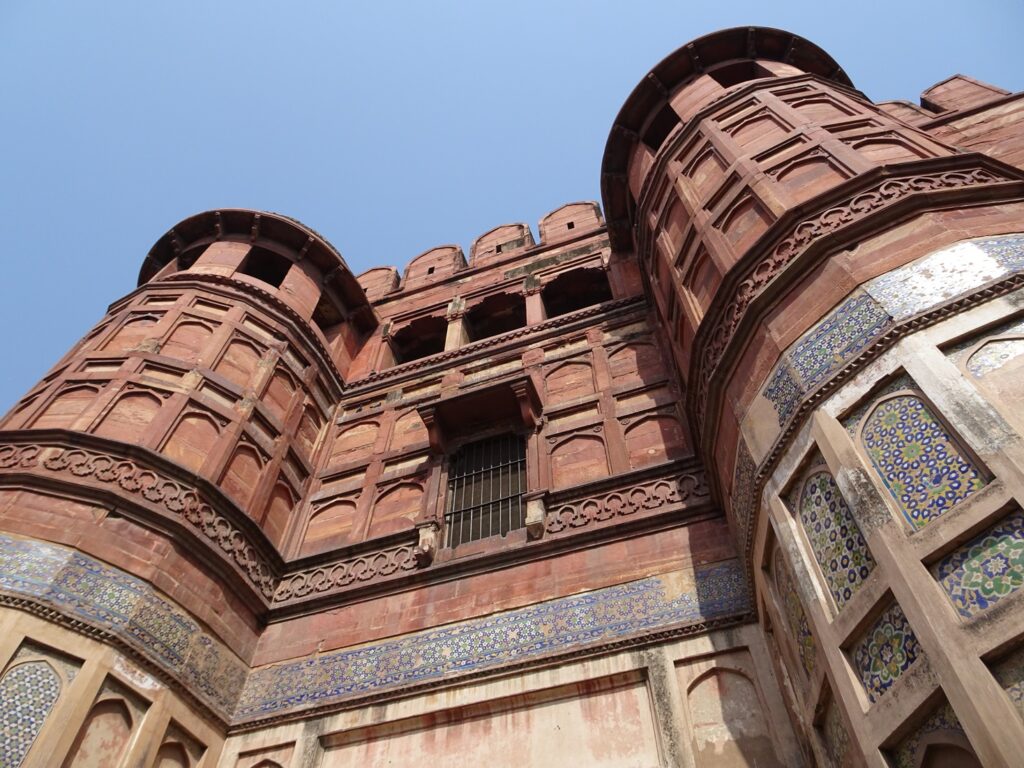
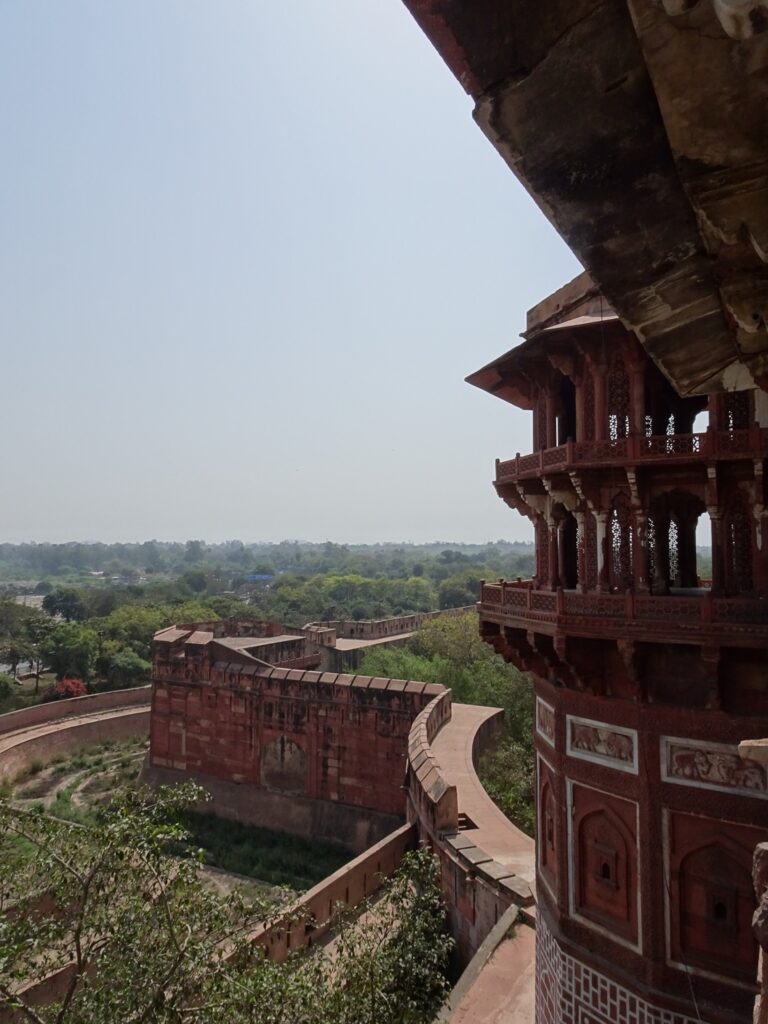
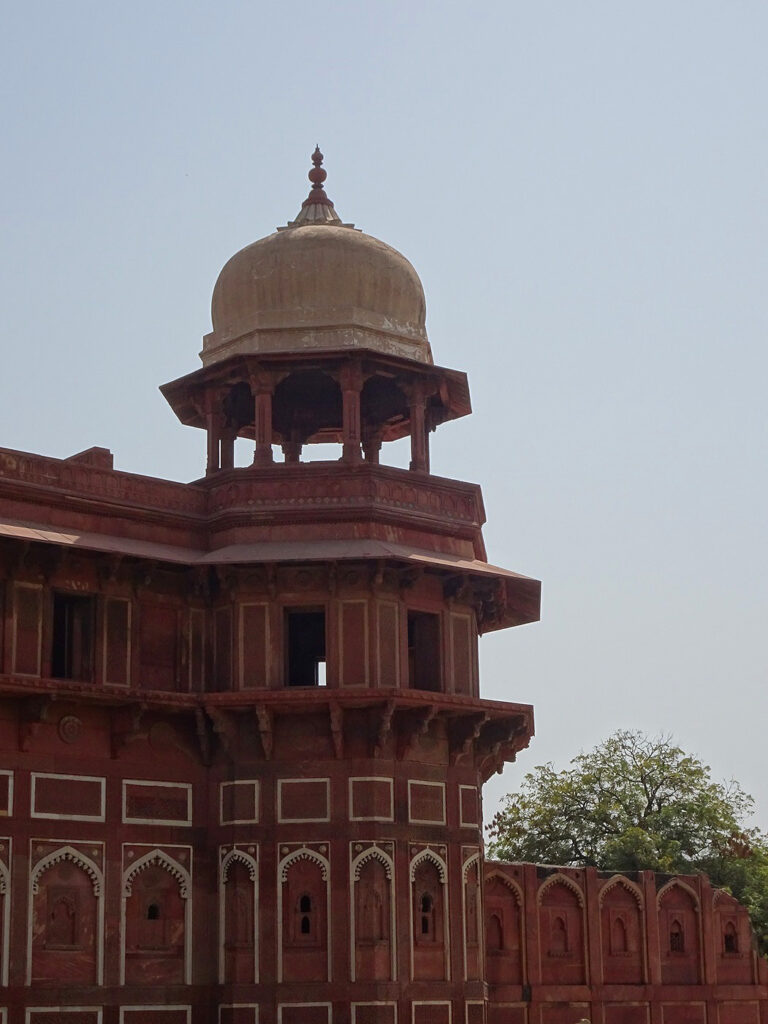
For that reason, the building sometimes feels pretty incongruous. It’s basically the opposite of the Taj Mahal, where all parts fit together beautifully. Once again, I found it interesting to try and discern the different phases of the Fort’s use by looking at the architecture.
For instance, the red sandstone walls around the complex are enormous, as is Amar Singh Gate, which is the main entrance to the fort. The passage curves sharply between the massive walls, which I assume was meant to slow down any potential invaders.
Inside, there are a few impressive living quarters that are also made from red sandstone, of which my favourite was Jahangir Mahal, the palace of Akbar’s son, Emperor Jahangir, which you can see to the right after you enter the fort.
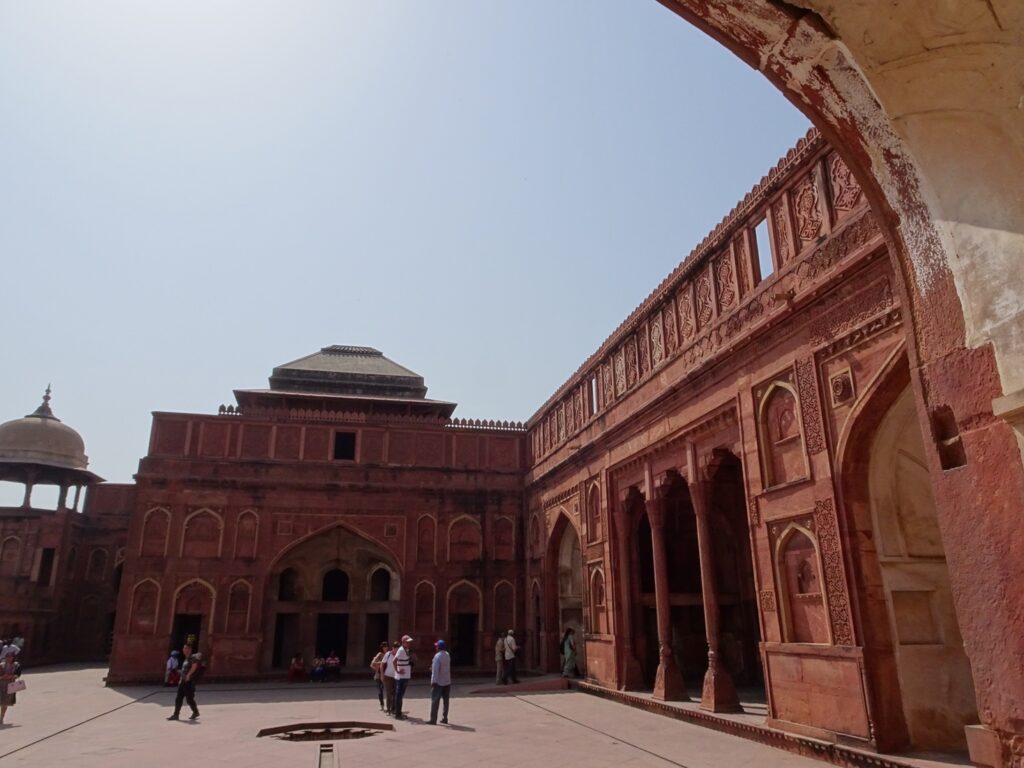
Apart from this and the Akbari Mahal, where the imperial consorts lived, there aren’t many remaining buildings from Akbar’s time, as Shah Jahan had lots of them torn down and replaced by more delicate white marble counterparts.
One of them is the open Diwan-i-Am Hall, which was used for official ceremonies and meetings with subjects, while the smaller white marble Diwan-i-Khas on the opposite side of the courtyard was used as a more private audience hall for diplomats and important guests.
Both have interestingly carved pillars and peacock arches, but I think I preferred Diwan-i-Khas with its carved reliefs of vines and flowers. Another pretty structure is the nearby Nagina Masjid, a small open marble mosque with three cupolas, which was built for the women of the imperial court.
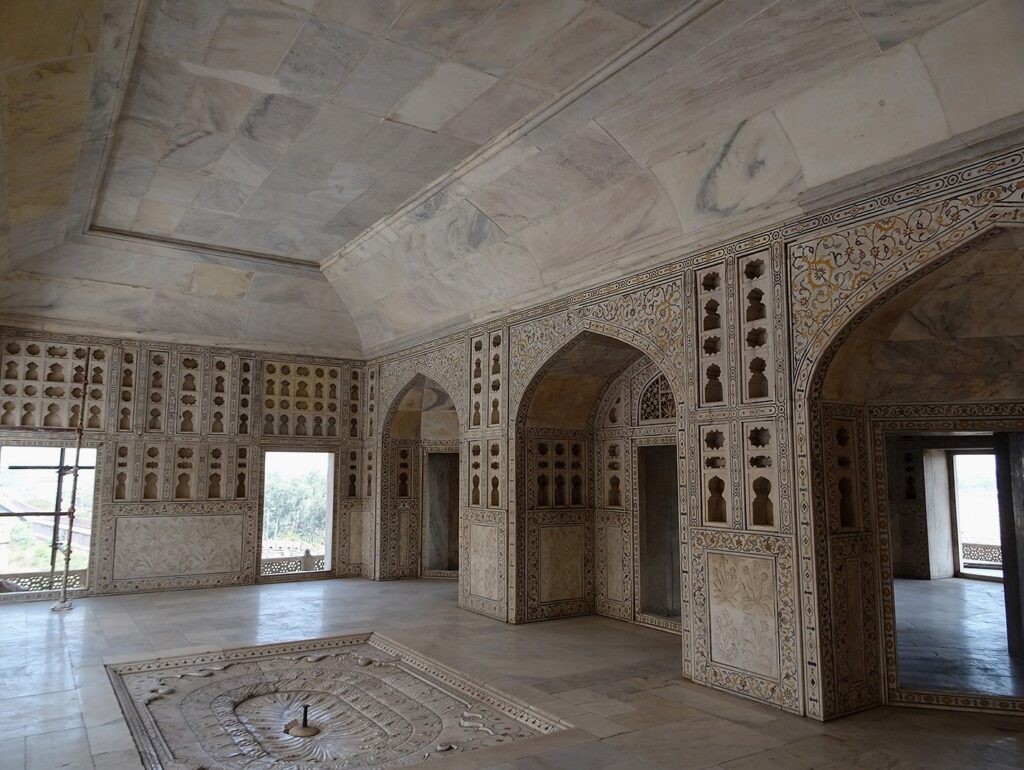
One of my favourite buildings in the fort was the Musamman Burj, which is an octagonal marble tower, in which Shah Jahan is said to have been imprisoned by his son Aurangzeb near the end of his life. There are some beautiful carved marble lattices and ornamental niches inside and from the top of the tower, there are some great views of the Taj Mahal across the Yamuna floodplains.
Practicalities
The fort is open from sunrise to sunset and we paid 650₹. The entrance is at the southern tip of the complex opposite Dr. Ambedkar Chowk Metro Station.
There is a lot to see, but the complex is smaller than some other forts we had visited in India (*cough* Chittorgarh *cough*), and I think an hour or 90 minutes should definitely be enough to do the place justice.
Day 2
Taj Mahal
The Taj is one of the most famous and popular sights in the world, which means that it can get insanely crowded. If you want only the slightest chance of enjoying the place without tons of other people around, you’ll have to get up before dawn (make sure to still get some breakfast before, though, as there are no cafés in the grounds!).
We arrived at the eastern gate around 6am and there were already quite a few people queuing, but we could still find enough quiet spots in the complex. When we left a little after 9am, there were already ten times as many and when we watched the building later in the day from the outside, the platform around the tomb was completely crowded.
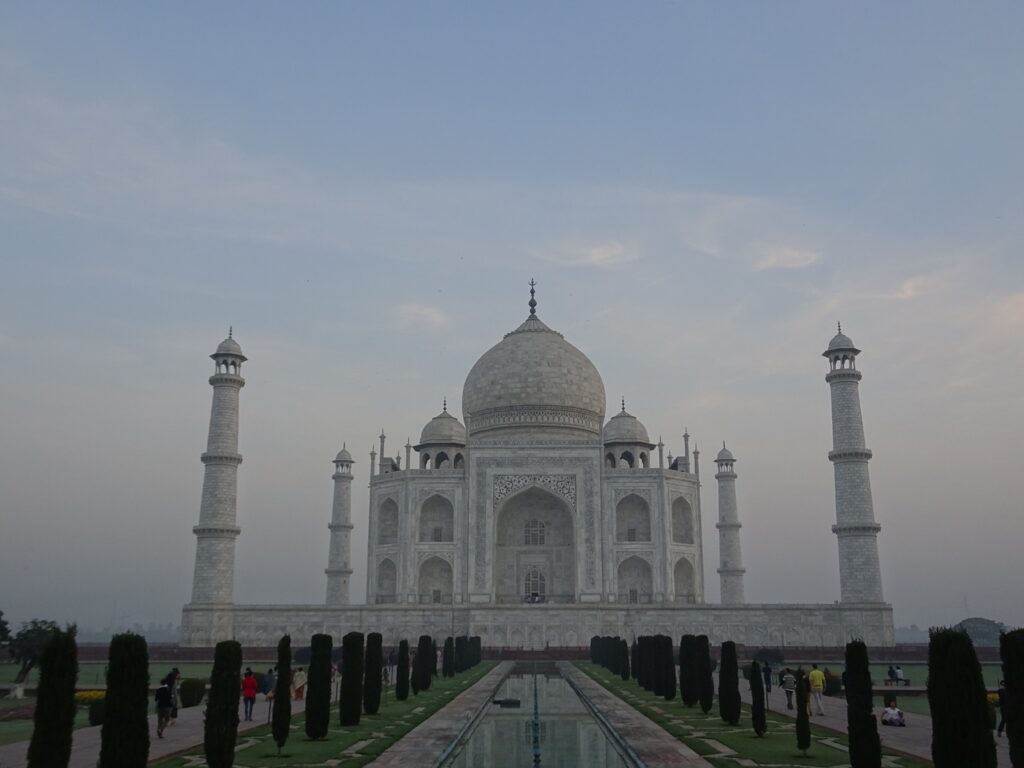
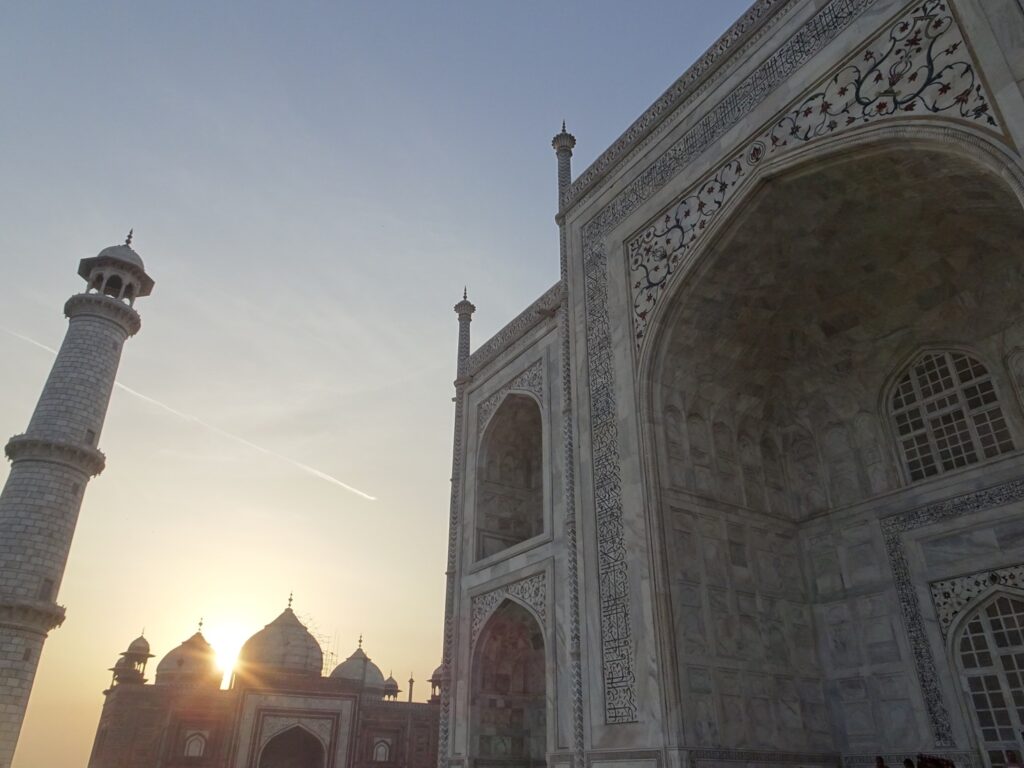
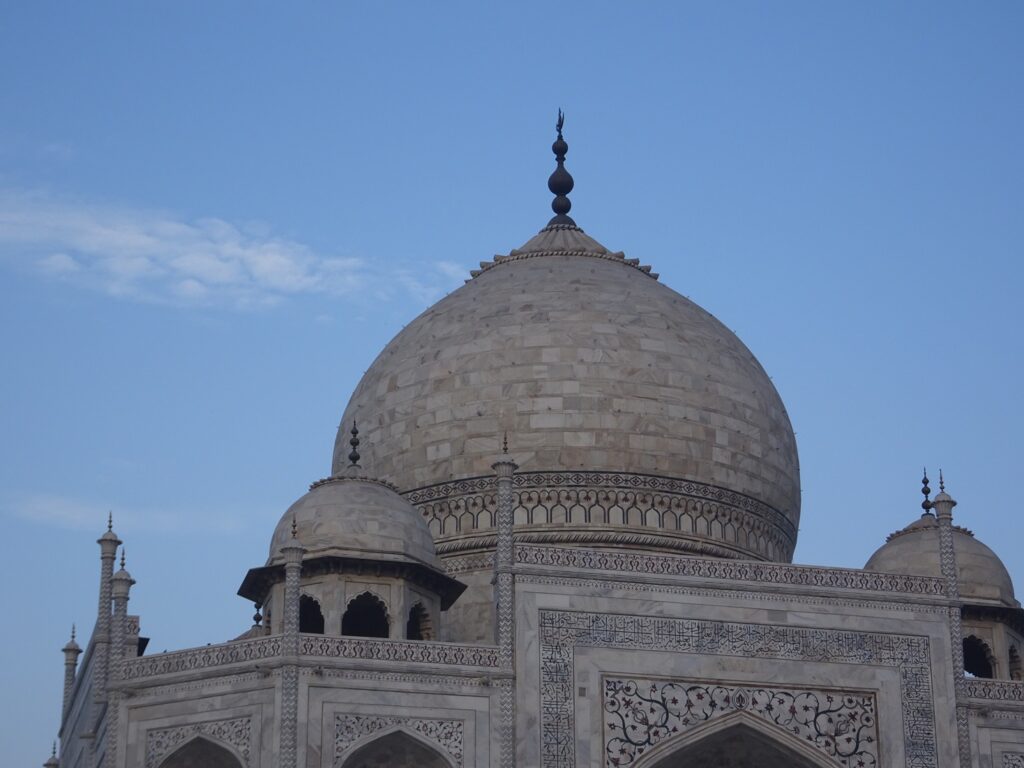
The Taj Mahal was commissioned by Emperor Shah Jahan after the death of his wife Mumtaz Mahal in 1631. It was constructed for over twenty years by specialized craftsmen from all over the Mughal Empire, but also from Persia, Syria and Uzbekistan.
The entire complex was designed around ideas of symmetry and paradise imagery from Islamic architecture. For instance, the charbagh – the partitioned formal garden with the reflecting pool in front of the tomb – represents the four gardens and four rivers of Paradise from the Quran.
The layout differs from other charbaghs, where the tomb is usually in the centre of the garden, like it is at Itimad-ud-Daulah or Akbar’s Mausoleum. The theory is that they changed that at the Taj, because they wanted to properly use the prime location by the Yamuna River.
Something we really liked about the tomb building itself were the beautiful ornaments all over the façade. Like everyone else, we had seen about a billion pictures of the Taj Mahal before coming there, but on these, it usually looks smooth and rather simple.
When we got close, we noticed that there are some carved marble screens and loads of Quranic inscriptions around the gates and pishtaqs (arched recesses), as well as flowers that are either carved as reliefs from the marble or created by colourful inlays of precious stones.
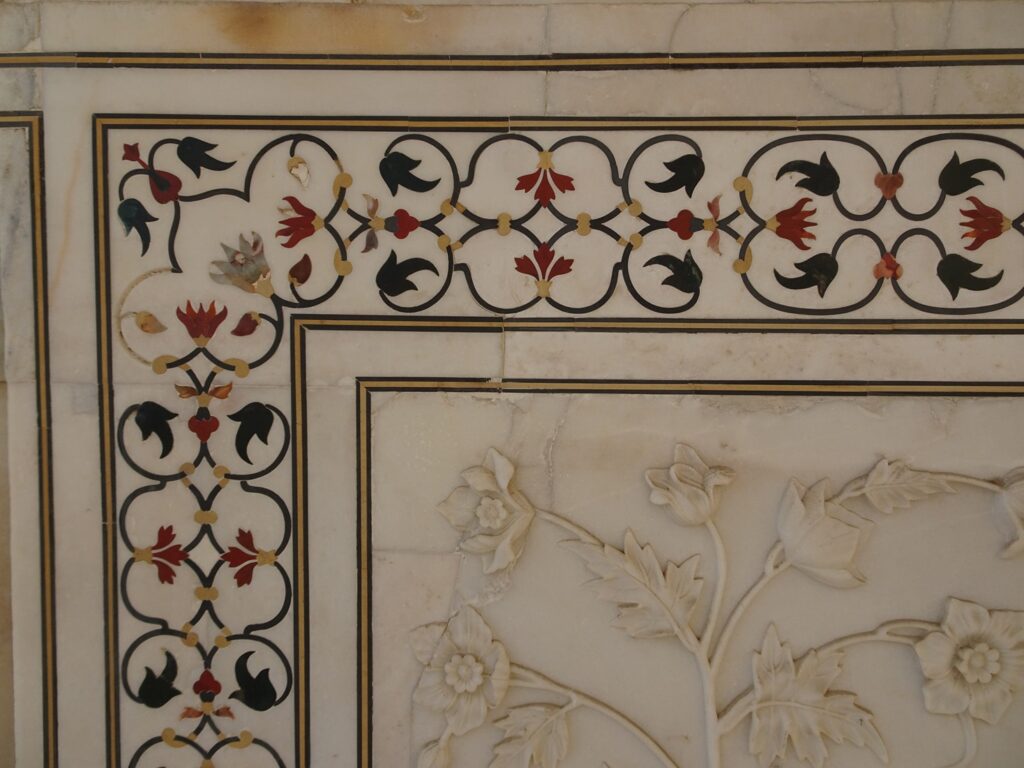
Inside the mausoleum, the central chamber holds the decorative cenotaphs of Mumtaz Mahal and Shah Jahan, surrounded by a super impressive filigree screen, which was carved out of a single piece of marble. The actual tombs lie in the basement below and can’t be visited.
Around the main tomb there are a number of other interesting buildings. For instance, the red sandstone mosque to the west and the matching jawab (guest pavilion) to the east create a nice contrast with the white marble of the Taj in the middle.
I’m also confident that these buildings would be star attractions in their own right anywhere else, with their beautifully painted and carved walls and domes. The same goes for the Darwaza-i-Rauza, the massive red stone entrance gate to the complex, that everyone just rushes through on their way to the tomb.
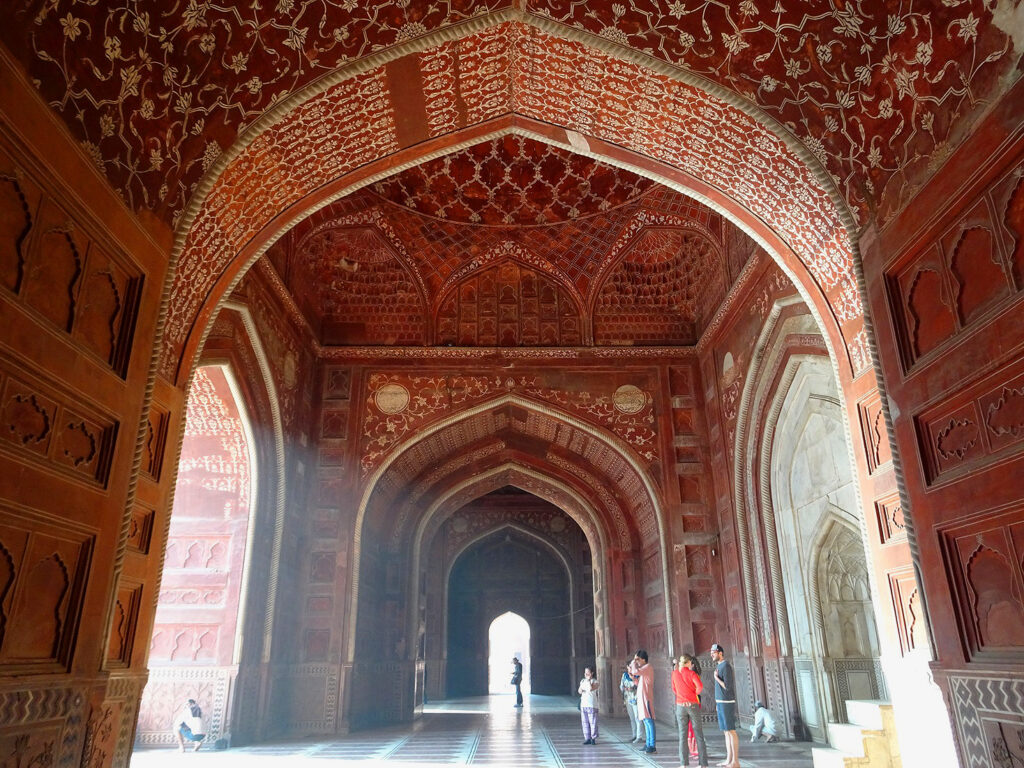
Another building I liked was the Naqqar Khana or Drum House at the eastern end of the charbagh, where musicians used to announce the entrance of the Emperor in Mughal times. It also seems to have been quite dangerous, as the Mughal Emperors Jahandar Shah and Farrukhsiyar both are said to have been assassinated here.
On the opposite side is the small Taj Museum, which only opens at 9am. We stuck around that long because we’re utter completionists, but unless you’re the same, I’d say it’s not essential.
The exhibits focus on the history and construction of the tomb, but a lot of them are just copies and reproduction of historic plans and documents. The most interesting exhibits to me were some pretty jade objects from Mughal times, including an impressive carved Quran Stand.
Practicalities
The Taj Mahal grounds are open from around 30 minutes before sunrise to 30 minutes before sunset every day except for Fridays, when the mosque is used for friday prayers (double-check the times here). Like I wrote above, it’s best to arrive shortly before dawn to avoid the worst of the crowds.
You can enter the compound through the eastern or western gate (the southern gate is just open as an exit gate). We used the eastern gate opposite the aptly named Taj East Gate Road, as it’s said to usually be less crowded.
Obviously, we don’t have a real point of comparison, but judging from the numbers of people streaming in from the opposite side, it looked like there were indeed a few fewer people at the eastern gate.
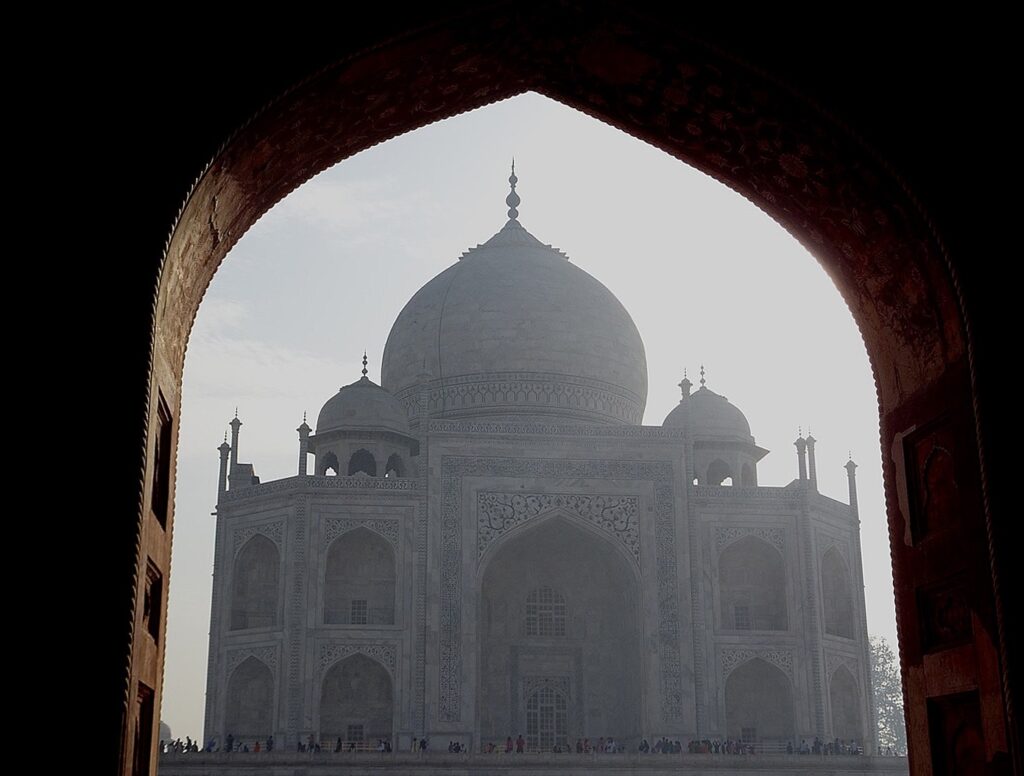
The general entrance fee is 1,100₹ for most foreigners, 540₹ SAARC and BIMSTEC citizens and 50₹ for Indian citizens. Visiting the inside of the main mausoleum is another 200₹ (for everyone). If you made it this far, I think you shouldn’t skip the inside of the Taj, so just get the full ticket.
Because there are religious sites in the compound, you should wear clothes that cover your knees and shoulders. You’re allowed to take photos everywhere except for the main tomb and you’re not allowed to bring a tripod into the grounds. The same goes for food, alcohol, tobacco and knives.
People will search your bags at the entrance, but if you carry anything that’s prohibited, there are lockers at the gates.
Akbar’s Tomb
Afterwards you might want to grab something to eat (there are tons of small cafés and food stalls in the streets directly south of the Taj), before moving on to Akbar’s Mausoleum in the city’s Sikandra neighbourhood.
The tomb complex was begun by Emperor Akbar himself and completed by his son Jahangir in the early 17th century. This might be the reason why it seems so strange with its incongruous upper story which looked to us as if they just lifted a completely different building on top of the lower structure.
Once again, the tomb is surrounded by a formal garden in the classic geometrical charbagh style, with the mausoleum standing in the centre and four walkways spreading out in all the cardinal directions.
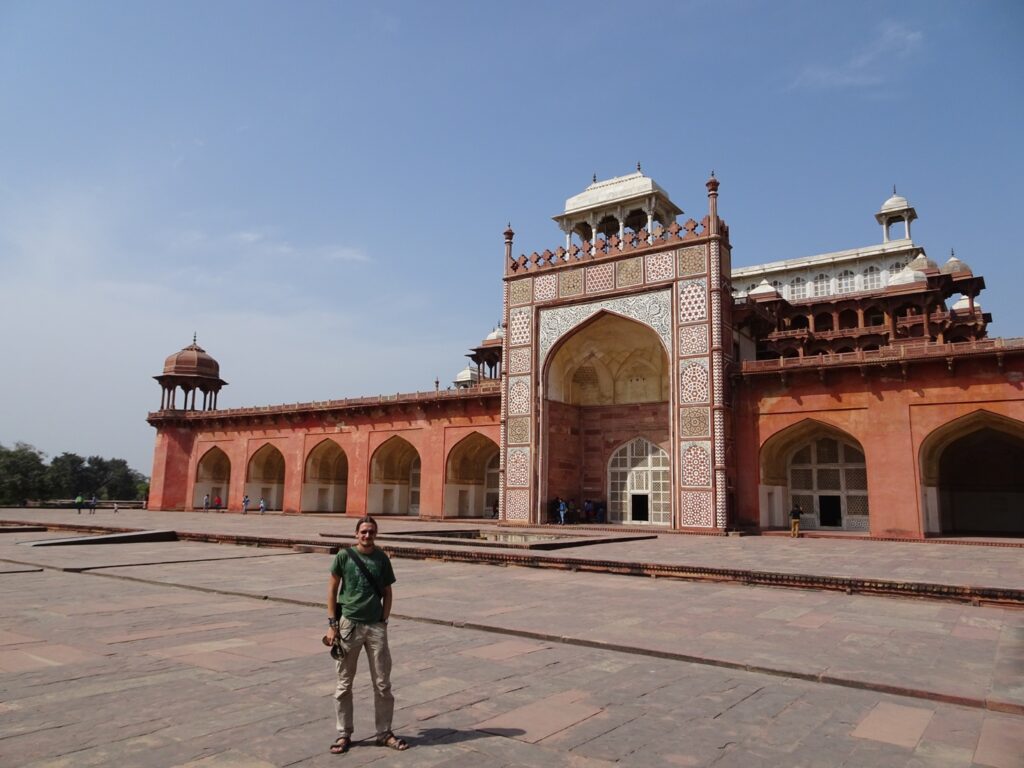
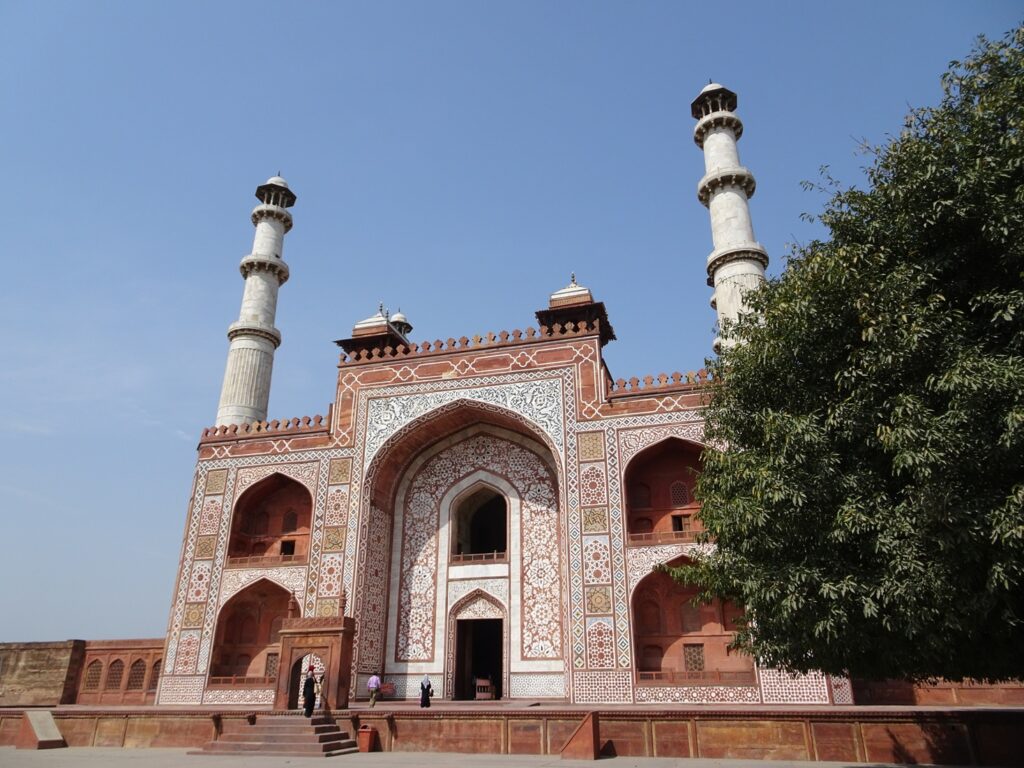
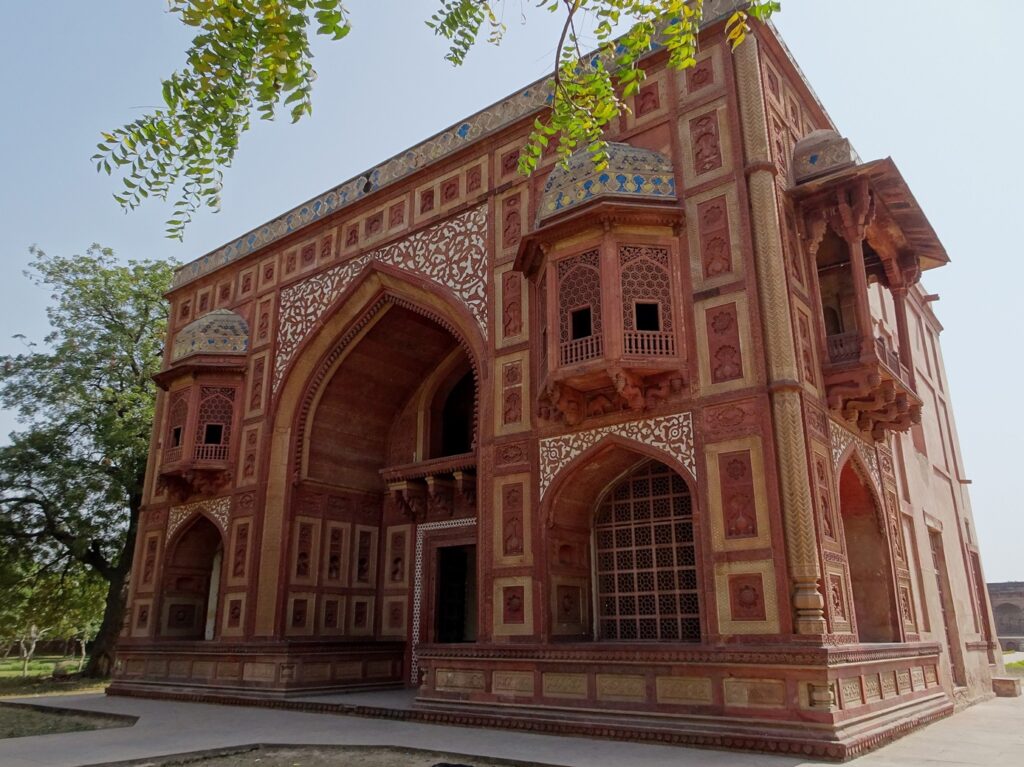
As with the Taj Mahal, the central chamber contains Akbar’s symbolic cenotaph, while the actual burial chamber lies underneath it. Once again, there’s a beautiful carved marble lattice screen, although this one completely covers the surrounding gateways.
The complex was quite peaceful when we visited and felt almost rural to us, especially as we saw lots of deer grazing in the garden (and a few monkeys, but even they seemed chilled out compared to others we encountered in the country).
Once again, there are a few interesting smaller buildings in the complex. For one, we found the massive southern gateway with its detailed inlay work and slender marble minaret just as impressive as the tomb itself. To be honest, we thought it actually was the tomb, when we first arrived.
Another structure we liked was the small Kanch Mahal (“Glass Palace”) to the south east of the entrance gate. There’s no consensus on what purpose it once served, but its northern wall is decorated in some beautiful tilework.
Practicalities
The mausoleum is open daily from sunrise to sunset and we paid an entrance fee of 300₹. The tomb is in the north-western outskirts of the city off National Highway 19.
As of 2026, there’s work going on to extend the Agra Metro Yellow Line to Sikandra, so at some point in the future, you’ll be able to get there from the Taj by metro. We took a Mathura-bound bus from the Bijlighar bus stand at the roundabout to the west of Agra Fort. You can get there by taking the metro from the Taj Mahal. Otherwise, any taxi or auto rickshaw driver will take you there.
Mehtab Bagh Garden (Taj Viewpoint)
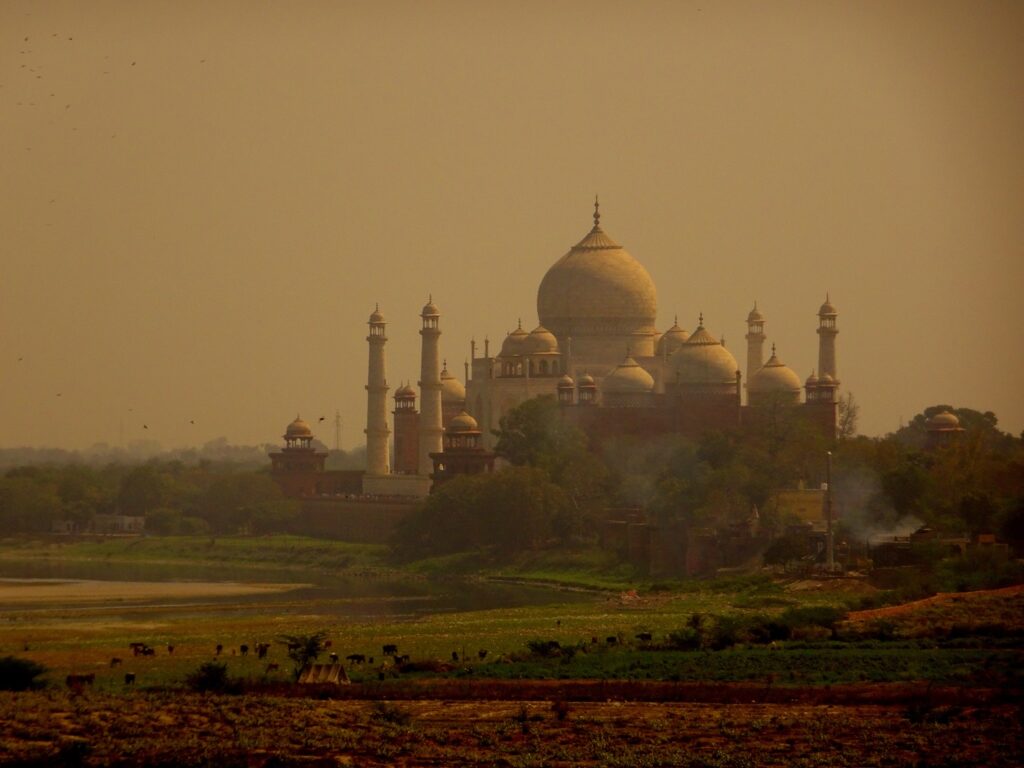
In the later afternoon, I recommend checking out another view of the Taj Mahal. Make your way back to central Agra and then cross the Yamuna River. Mehtab Bagh Park sits directly opposite the Taj Mahal on the northern side of the river.
The garden was originally laid out during the Mughal period as part of a larger sequence of riverside gardens that were aligned with the Taj Mahal. From here, you get one of the best symmetrical views back toward the monument itself.
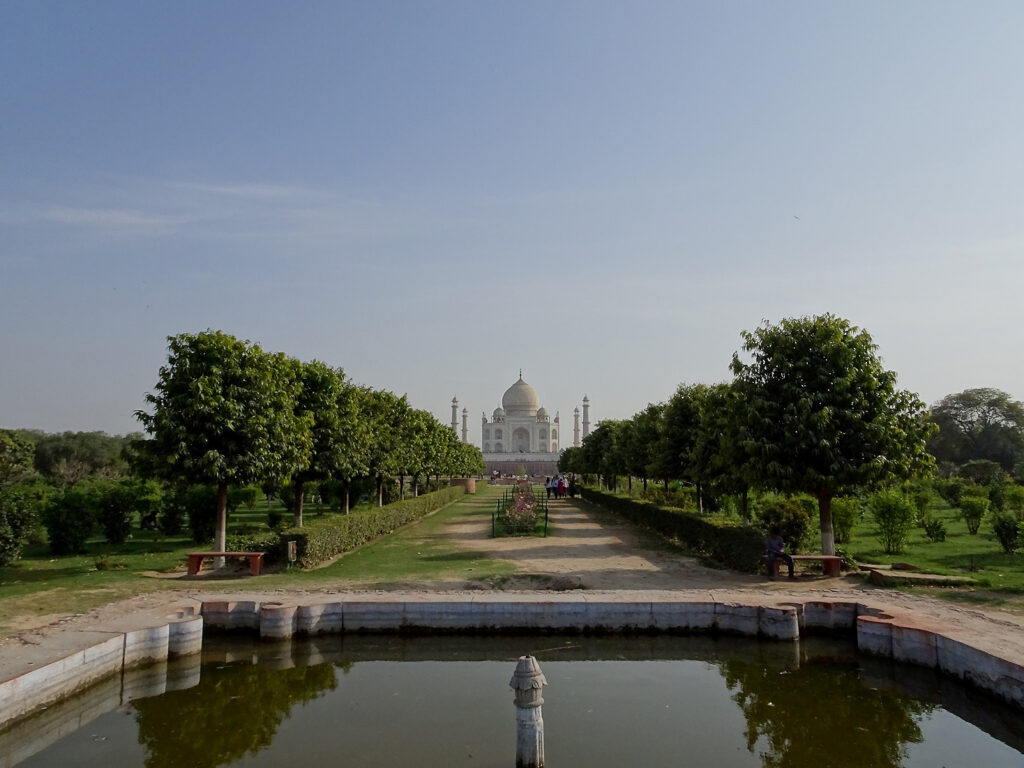
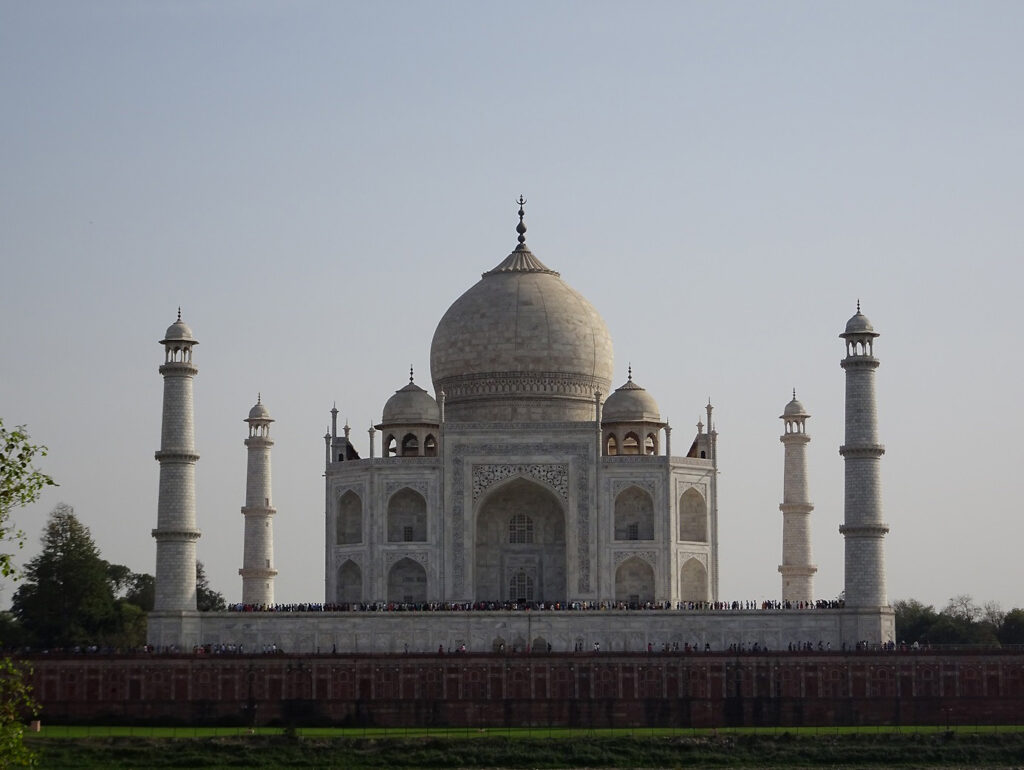
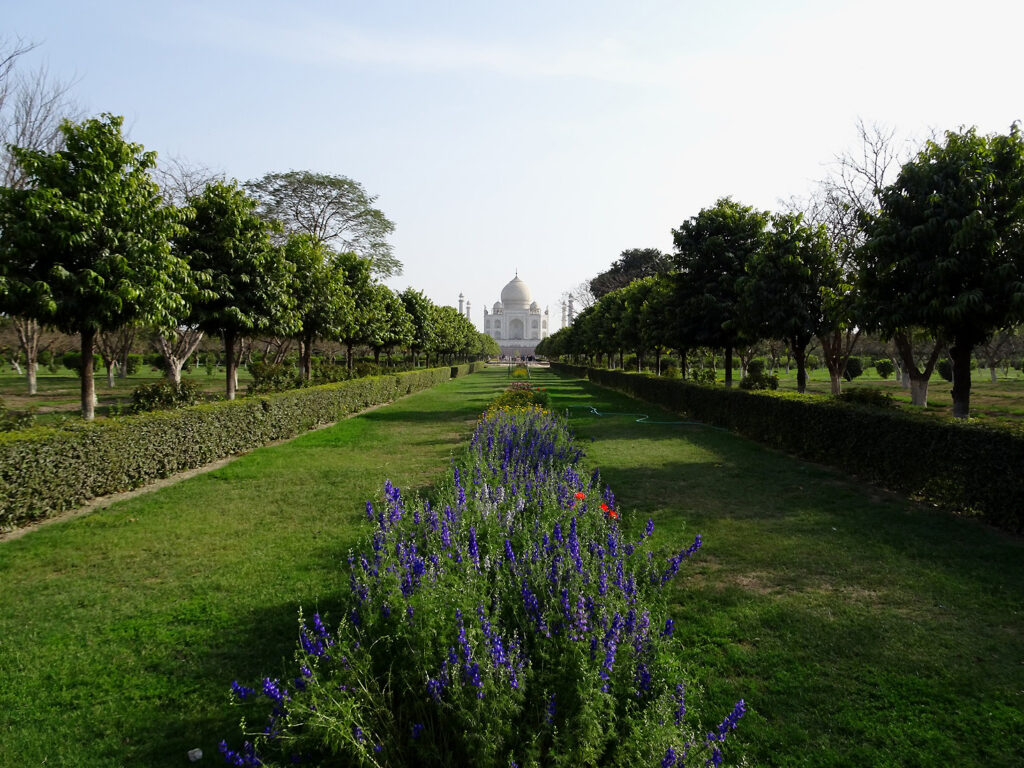
What you see is the rear side of the Taj, but as the layout is symmetrical all around, it’s no less impressive than from the front and it has the added bonus that there won’t be lots of people in your photographs if you snap them from here.
The garden is open from sunrise to sunset and we paid an entrance fee of 300₹. We got an auto rickshaw here from near the fort.
Agra Itinerary Map
All of the places from my itinerary can be found in this map of Agra. Stops from Day 1 are marked with red pins and stops from Day 2 with yellow pins. The green markers show the locations of the city’s main train and bus stations.
Practicalities
How to Get to Agra
Agra has several big railway stations, with Agra Cantt handling most long-distance services. From Delhi, the fastest trains take around 1.5 to 2 hours. There are also direct connections to Jaipur, Varanasi, Lucknow, Gwalior and many other cities. You can look for connections on the Indian Railways Site.
There are also regular buses connecting Agra with Delhi, Jaipur and other cities across Uttar Pradesh and Rajasthan. They’re usually cheaper than the train but generally a bit slower. For shorter routes, buses can still be a reasonable alternative, and we actually took the bus to Delhi from the Idgah Bus Station near Agra Cantt, as it was Holi and all the trains were booked out.
How to Get Around
The sights outside of the centre are all a bit spread out and in many cases too far to walk to (although we actually walked to the Itimad-ud-Daulah and Chini Ka Rauza, but then again, we’re used to walking in traffic-heavy metropolises).
Otherwise, we mostly took auto rickshaws to get around. If you want to do the same, you’ll have to haggle for a bit, as some of the prices quoted by the drivers in Agra were the highest we had heard in the entire country and sometimes we ended up paying less than a tenth of what they first demanded.
It’s usually a good idea to ask at your hotel or guesthouse how much a certain trip should cost and use that as a frame of reference. Cycle rickshaws are usually cheaper, but of course also a lot slower.
To get to Akbar’s Mausoleum, we took a Mathura-bound bus from the Bijlighar bus stand at the roundabout to the west of Agra Fort, but it took quite long, so using an auto-rickshaw might be the better way to go here, as well.
Since 2024, there’s a metro in Agra, which is successively going to be enlarged. As of 2026, it’s useful to travel between the Taj Mahal and Agra Fort. The only existing line (Yellow Line) currently runs between Taj East Gate Station and Mankameshwar Station near the Agra Fort Railway Station.
Where to Stay
If you want an early start for the Taj Mahal, the best area to stay in Agra is either the Kinari Bazaar area directly to the south of the Taj or the slightly quieter area a little further east along the Taj East Gate Road.
We stayed in the dormitory at Big Brother Hostel, which was a bit stuffy, but still good value. There are lots of mid-range options around the Taj, too, like Hotel Ten Square, as well as some really well-rated luxury choices, like The Oberoi Amarvilas Agra.